
Recently, the “China Broadband Development White Paper 2022” released by the China Academy of Information and Communications Technology shows that in the past year, China has solidly promoted the construction and deployment of broadband infrastructure such as 5G, gigabit optical networks, data centers, and cloud computing, and with the joint efforts of government, industry, academia and research, broadband networks have further accelerated and improved their quality in various aspects such as basic support capacity, application facility service level, network investment scale, industrial competitiveness, integration and application degree, inclusive people’s livelihood level, energy conservation and emission reduction efficiency, etc., and achieved a series of landmark results. Among them, China’s basic support capacity has achieved leapfrog development.
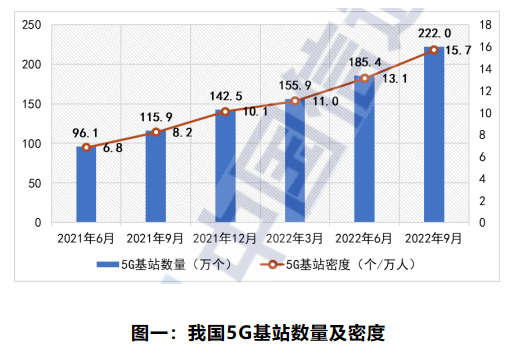
5G networks enable “county-to-county connectivity”. As of the end of September 5, China has built and opened a total of 2022.9 million 5G base stations, 222G network in the country to achieve coverage of all cities above the prefecture level, further extended to cover all counties and towns and key townships in the country, the national 5G base station density is 5.15 / 7,1 people, up to 9.5 times the same period last year, Beijing, Shanghai, Tianjin, Zhejiang 20G base station density exceeded 5 / 5,1. China’s 1G mobile phone user scale ranks first in the world, reaching 8 million households, 30.3 times that of the same period last year, accounting for 5.<>% of mobile phone users, and the penetration rate of <>G mobile phones in Qinghai, Beijing, Guangdong, Ningxia, Zhejiang and other regions ranks first in the country.
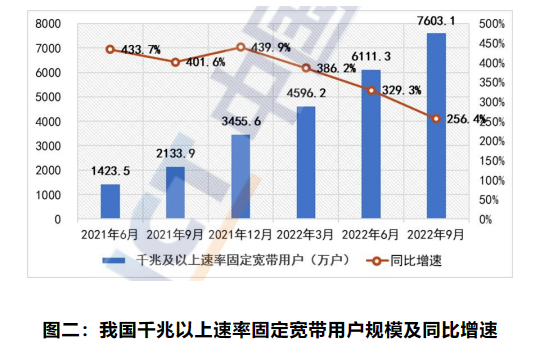
Gigabit optical networks realize “city-to-city communication”. China has built the world’s largest optical fiber network, and as of the end of September 2022, the number of optical fiber ports reached 9 billion, a year-on-year increase of 10.7%. The number of optical fiber subscribers reached 9 million, ranking first in the world. The deployment of gigabit optical networks has accelerated, and the scale of 5G-PON and above ports in China has reached 5.10 million, a net increase of more than 1267.9 million over the end of 2021. Gigabit optical networks have the ability to cover more than 480 million households, reaching all urban areas in the country, and the scale of gigabit and above fixed broadband users has exceeded 4.5 million, a net increase of more than 7603 million over the end of 1.
The historic realization of “broadband from village to village”. As of the end of November 2021, 11,51 village-level units across the country have access to broadband, and the proportion of administrative villages and poor villages connected to broadband has increased to 100%, achieving dynamic zero access to unconnected administrative villages, and solving the problem of communication difficulties in poor areas historically. In 2022, the eighth batch of telecom universal service pilot projects will support the construction of more than 9000,4 rural 5G and 5G base stations across the country, and gradually promote the construction of <>G networks in rural areas with conditions and needs.
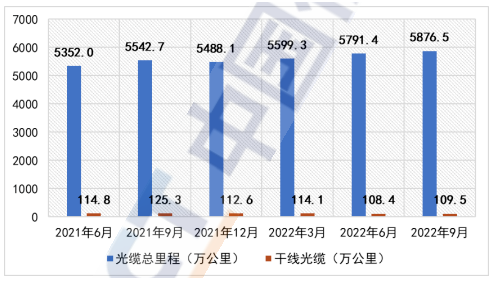
The comprehensive carrying capacity of the backbone transmission network continued to increase. As of the end of September 2022, the total length of China’s optical cable lines reached 9.5876 million kilometers, a year-on-year increase of 5%, of which the line optical cable reached 6.109 million kilometers, and the replacement of trunk optical cables accelerated and entered the era of new ultra-low-loss optical fibers. The backbone transmission network continues to expand capacity, gradually evolving to 5G/200G ultra-high-speed, ultra-large-capacity transmission systems, accelerating the development and application of flexible all-optical crossover, intelligent management and control technologies, and continuously improving network scheduling capabilities and service efficiency.

The all-round, multi-level and three-dimensional network interconnection architecture is further optimized. As of the end of September 2022, with the completion and opening of national Internet backbone direct connection points in Jinan, Qingdao, Harbin and Changsha, the number of national Internet backbone direct connection points in China has reached 9. Four new Internet exchange centers in Hangzhou, Zhejiang, Zhongwei in Ningxia, Qianhai in Shenzhen and Lingang in Shanghai have been piloted, and the top-level structure of the Internet network has been moving towards the all-round three-dimensional of “backbone direct connection + new Internet exchange center”. Network communication performance continues to improve, network, latency, and packet loss rates drop significantly, and the overall network performance maintains a world-class level.